Today we tried to run our play again.
The group just don't understand 'The Importance of being Ernest' and I've tried to explain it more than enough times.
If they really didn't want to do it they would stop turning up to rehearsals but Milo, Rose, Specs, Kinsey and Allen do despite protesting.
The only reason I want to do this play is to convince the courts that I have changed and I'm safe for release. I hate it here, all the medicine and all the 'Health & Safety' its utter rubbish, no one is safe in here. The only reason I feel any safe is because half of the people in here are so off their face on the drugs they have forced upon them that they can barely string a sentence together.
I think I'm probably the most innocent in the whole of this place, I didn't do anything.
I was lead straight up the garden path and it wasn't fair, I don't deserve to be in this place I deserve to be back at home with my family and living my life.
Monday, 4 April 2016

Subtext Exercise
As you can hear in the video every time we believe there is a deeper meaning to what we say we clap to signal that we are going to speak and then we say what we believe is on our minds.
This is a really good exercise because it allows us to explore and improve our characterisation as we try to read between the lines of the script and improve our understanding of the people we are trying to portray.
After this exercise I felt much more comfortable playing George as it felt more natural.
Sunday, 3 April 2016
Modern Mental Health Centres
I did some research on mental health centres and discovered the institute of mental health in Nottingham.
I read the about us page on their "centre of health & Justice" which is much like the institute that "A Handbag" is set in.
The brief description reads as follows;
"The Centre for Health and Justice, led by Professor Eddie Kane, is a major national development in the understanding of and provision for mentally disordered offenders.
The Centre brings together research, policy and practice in the fields of mental and general health care and criminal justice, through an innovative multi-disciplinary approach. It carries out clinically focused and practically designed research to provide the evidence base to build a new generation of services. Chair of the new Centre’s Advisory Board is Lord David Ramsbotham, formerly HM Chief Inspector of Prisons."
source: http://www.institutemh.org.uk/x-about-us-x/our-centres/centre-for-health-and-justice
I also took time to read the information brochure pdf which contains a lot of information about how they operate.
"the centre seeks to discover the best ways to deliver healthcare in the justice environment and secure health settings. It will bring together research, policy, and practice in the fields of mental and general health care and criminal justice, through an innovative multi-disciplinary approach. It will carry out clinically focused and practically designed research to provide the evidence base to build a new generation of services. The centre will support education and training programmes (such as the Knowledge and Understanding Framework for people with personality disorders) that appeal to a multidisciplinary audience, bringing agencies together from across health and criminal justice. The Centre for Health and Justice’s key partnerships:
• Institute of Mental Health (i.e. Nottinghamshire Healthcare NHS Trust and the University of Nottingham);
• Frontline justice, police, probation, and NHS staff;
• Commercial/independent providers;
• Criminal justice programme from the Centre for Mental Health;
• Policy makers and senior politicians in health and justice;
• Colleagues from the UK and international clinical, academic, and policy networks and other universities."
http://www.institutemh.org.uk/images/CHJ_Newsletter_no._1_FINAL.pdf
I read the about us page on their "centre of health & Justice" which is much like the institute that "A Handbag" is set in.
The brief description reads as follows;
"The Centre for Health and Justice, led by Professor Eddie Kane, is a major national development in the understanding of and provision for mentally disordered offenders.
The Centre brings together research, policy and practice in the fields of mental and general health care and criminal justice, through an innovative multi-disciplinary approach. It carries out clinically focused and practically designed research to provide the evidence base to build a new generation of services. Chair of the new Centre’s Advisory Board is Lord David Ramsbotham, formerly HM Chief Inspector of Prisons."
source: http://www.institutemh.org.uk/x-about-us-x/our-centres/centre-for-health-and-justice
I also took time to read the information brochure pdf which contains a lot of information about how they operate.
"the centre seeks to discover the best ways to deliver healthcare in the justice environment and secure health settings. It will bring together research, policy, and practice in the fields of mental and general health care and criminal justice, through an innovative multi-disciplinary approach. It will carry out clinically focused and practically designed research to provide the evidence base to build a new generation of services. The centre will support education and training programmes (such as the Knowledge and Understanding Framework for people with personality disorders) that appeal to a multidisciplinary audience, bringing agencies together from across health and criminal justice. The Centre for Health and Justice’s key partnerships:
• Institute of Mental Health (i.e. Nottinghamshire Healthcare NHS Trust and the University of Nottingham);
• Frontline justice, police, probation, and NHS staff;
• Commercial/independent providers;
• Criminal justice programme from the Centre for Mental Health;
• Policy makers and senior politicians in health and justice;
• Colleagues from the UK and international clinical, academic, and policy networks and other universities."
http://www.institutemh.org.uk/images/CHJ_Newsletter_no._1_FINAL.pdf
A Handbag play research
Samuel French;
I found a description of 'a handbag' on "http://www.samuelfrench-london.co.uk/p/11345/handbag-a"
which briefly describes the main plot of the play as well as why it was commissioned it reads as follows;
"Acclaimed novelist, screenwriter and playwright Anthony Horowitz was commissioned to write a play as part of the National Theatre's New Connections programme for young people and the result is a short play which is both funny and poignant for a cast of six.
A group of young people are rehearsing The Importance of Being Earnest but, as they attempt to perform a play which is alien to them, it becomes apparent that their surroundings are not normal. Gradually, as tensions mount, squabbles ensue and each young person's story starts to emerge, the location is found to be an institution - reinforced by the final grim, chilling echoes of doors slamming and being locked.
Rose, also Lady Bracknell. George, also Jack Worthing. Allan, also Algernon Moncrieff. Specs, also Algernon, Gwendolen, Jack, Cecily. Irene also Gwendolen. Kinsey also Lane."
I found a description of 'a handbag' on "http://www.samuelfrench-london.co.uk/p/11345/handbag-a"
which briefly describes the main plot of the play as well as why it was commissioned it reads as follows;
"Acclaimed novelist, screenwriter and playwright Anthony Horowitz was commissioned to write a play as part of the National Theatre's New Connections programme for young people and the result is a short play which is both funny and poignant for a cast of six.
A group of young people are rehearsing The Importance of Being Earnest but, as they attempt to perform a play which is alien to them, it becomes apparent that their surroundings are not normal. Gradually, as tensions mount, squabbles ensue and each young person's story starts to emerge, the location is found to be an institution - reinforced by the final grim, chilling echoes of doors slamming and being locked.
Rose, also Lady Bracknell. George, also Jack Worthing. Allan, also Algernon Moncrieff. Specs, also Algernon, Gwendolen, Jack, Cecily. Irene also Gwendolen. Kinsey also Lane."
Tes.com;
I found this picture as well which also gives a brief description of the play but from a different angle.
It takes a new light to who the characters are supposed to be based on and some suggestions on how they should be played.

I found this picture as well which also gives a brief description of the play but from a different angle.
It takes a new light to who the characters are supposed to be based on and some suggestions on how they should be played.
Saturday, 2 April 2016
Research into James Bulger
We believe that Kinsey and George were based on the killers of infant James Bulger, Jon Venables and Robert Thompson. Here is some research I found on the Trials and Conviction.
Trial;
Up to five hundred protesters gathered at South Sefton Magistrates' Court during the boys' initial court appearances. The parents of the accused were moved to different parts of the country and assumed new identities following death threats from vigilantes.
The full trial opened at Preston Crown Court on 1 November 1993, conducted as an adult trial with the accused in the dock away from their parents, and the judge and court officials in legal regalia. The boys denied the charges of murder, abduction and attempted abduction brought against them. The attempted abduction charge related to an incident at the New Strand Shopping Centre earlier on 12 February 1993, the day of Bulger's death. Thompson and Venables had attempted to lead away another two-year-old boy, but had been prevented by the boy's mother. Each boy sat in view of the court on raised chairs (so they could see out of the dock designed for adults) accompanied by two social workers. Although they were separated from their parents, they were within touching distance when their families attended the trial. News stories reported the demeanour of the defendants.These aspects were later criticised by the European Court of Human Rights, which ruled in 1999 that they had not received a fair trial by being tried in public in an adult court.
At the trial, the lead prosecution counsel Richard Henriques QC successfully rebutted the principle of doli incapax, which presumes that young children cannot be held legally responsible for their actions. Thompson and Venables were considered by the court to be capable of "mischievous discretion", meaning an ability to act with criminal intent as they were mature enough to understand that they were doing something seriously wrong. The child psychiatrist Dr. Eileen Vizard, who interviewed Thompson before the trial, was asked in court whether he would know the difference between right and wrong, that it was wrong to take a young child away from his mother, and that it was wrong to cause injury to a child. Vizard replied, "If the issue is on the balance of probabilities, I think I can answer with certainty". Vizard also said that Thompson was suffering from posttraumatic stress disorder after the attack on Bulger. Dr. Susan Bailey, the Home Office forensic psychiatrist who interviewed Venables, said unequivocally that he knew the difference between right and wrong.
Post Trial;
The editors of The Sun newspaper handed a petition bearing nearly 280,000 signatures to Home Secretary Michael Howard, in a bid to increase the time spent by both boys in custody. This campaign was successful, and in July 1994 Howard announced that the boys would be kept in custody for a minimum of fifteen years, meaning that they would not be considered for release until February 2008, by which time they would be 25 years of age.
Detention;
After the trial, Thompson was held at the Barton Moss Secure Care Centre in Manchester. Venables was detained in Vardy House, a small eight-bedded unit at Red Bank secure unit in St. Helens on Merseyside — the same facility where, 25 years prior, Mary Bell had been held for half of her 12-year sentence. These locations were not publicly known until after the boys' release.
Details of the boys' lives were recorded twice daily on running sheets and signed by the member of staff who had written them. The records were stored at the units and copied to officials in Whitehall. The boys were taught to conceal their real names and the crime they had committed which resulted in them being in the units. Venables's parents regularly visited their son at Red Bank, just as Thompson's mother did — every three days — at Barton Moss.
The boys received education and rehabilitation; despite initial problems, Venables was said to have eventually made good progress at Red Bank, resulting in him being kept there for the full eight years, despite the facility only being a short-stay remand unit. Both boys, however, were reported to suffer posttraumatic stress disorder, and Venables in particular told of experiencing nightmares and flashbacks of the murder.
Source: https://en.wikipedia.org/wiki/Murder_of_James_Bulger
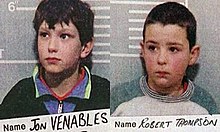
Trial;
Up to five hundred protesters gathered at South Sefton Magistrates' Court during the boys' initial court appearances. The parents of the accused were moved to different parts of the country and assumed new identities following death threats from vigilantes.
The full trial opened at Preston Crown Court on 1 November 1993, conducted as an adult trial with the accused in the dock away from their parents, and the judge and court officials in legal regalia. The boys denied the charges of murder, abduction and attempted abduction brought against them. The attempted abduction charge related to an incident at the New Strand Shopping Centre earlier on 12 February 1993, the day of Bulger's death. Thompson and Venables had attempted to lead away another two-year-old boy, but had been prevented by the boy's mother. Each boy sat in view of the court on raised chairs (so they could see out of the dock designed for adults) accompanied by two social workers. Although they were separated from their parents, they were within touching distance when their families attended the trial. News stories reported the demeanour of the defendants.These aspects were later criticised by the European Court of Human Rights, which ruled in 1999 that they had not received a fair trial by being tried in public in an adult court.
At the trial, the lead prosecution counsel Richard Henriques QC successfully rebutted the principle of doli incapax, which presumes that young children cannot be held legally responsible for their actions. Thompson and Venables were considered by the court to be capable of "mischievous discretion", meaning an ability to act with criminal intent as they were mature enough to understand that they were doing something seriously wrong. The child psychiatrist Dr. Eileen Vizard, who interviewed Thompson before the trial, was asked in court whether he would know the difference between right and wrong, that it was wrong to take a young child away from his mother, and that it was wrong to cause injury to a child. Vizard replied, "If the issue is on the balance of probabilities, I think I can answer with certainty". Vizard also said that Thompson was suffering from posttraumatic stress disorder after the attack on Bulger. Dr. Susan Bailey, the Home Office forensic psychiatrist who interviewed Venables, said unequivocally that he knew the difference between right and wrong.
Post Trial;
The editors of The Sun newspaper handed a petition bearing nearly 280,000 signatures to Home Secretary Michael Howard, in a bid to increase the time spent by both boys in custody. This campaign was successful, and in July 1994 Howard announced that the boys would be kept in custody for a minimum of fifteen years, meaning that they would not be considered for release until February 2008, by which time they would be 25 years of age.
Detention;
After the trial, Thompson was held at the Barton Moss Secure Care Centre in Manchester. Venables was detained in Vardy House, a small eight-bedded unit at Red Bank secure unit in St. Helens on Merseyside — the same facility where, 25 years prior, Mary Bell had been held for half of her 12-year sentence. These locations were not publicly known until after the boys' release.
Details of the boys' lives were recorded twice daily on running sheets and signed by the member of staff who had written them. The records were stored at the units and copied to officials in Whitehall. The boys were taught to conceal their real names and the crime they had committed which resulted in them being in the units. Venables's parents regularly visited their son at Red Bank, just as Thompson's mother did — every three days — at Barton Moss.
The boys received education and rehabilitation; despite initial problems, Venables was said to have eventually made good progress at Red Bank, resulting in him being kept there for the full eight years, despite the facility only being a short-stay remand unit. Both boys, however, were reported to suffer posttraumatic stress disorder, and Venables in particular told of experiencing nightmares and flashbacks of the murder.
Source: https://en.wikipedia.org/wiki/Murder_of_James_Bulger


George Character Profile
Name: George Johnson
Real Name: William Charlton
Sex: Male
Background Information;
George grew up as best-friends with Kinsey whose real name is Colin.
They used to get into mischief together, causing all the trouble they could; jumping in front of ice cream trucks to fake insurance claims and stealing from everyone they could.
George used to go on long bike rides with Kinsey including the bike ride to Worthing which was the last bike ride they went on before they were sent to the young offenders institute for committing their crime.
The whole group decided that George is a controlling character ,and although it might not seem like it, a lot of the time George is in control.
This is really obvious in the scene between him and Kinsey as George commands the situation every time that things go towards a subject he isn't comfortable with.
In the end Kinsey falls for George's usual "putting words" into other peoples mouth as he tells the group Kinsey agrees to the play when Kinsey actually said the complete opposite.
George has a fairly obvious relationship with all of the group as most of the fall in his lead because in reality it gives them all something to do whilst it allows George to perform a play he hopes will show his improvement from the mischievous, naughty chid he was in Worthing.
I don't think that George is actually in any way rehabilitated. Georges governing like tendencies are a prime example that he is an authoritarian and his non-wavering determination to have full control of everyone he is in contact with. Kinsey in his piece says about how everything they did was George's idea and from the way George behaves this is extremely likely to be the case.
Real Name: William Charlton
Sex: Male
Background Information;
George grew up as best-friends with Kinsey whose real name is Colin.
They used to get into mischief together, causing all the trouble they could; jumping in front of ice cream trucks to fake insurance claims and stealing from everyone they could.
George used to go on long bike rides with Kinsey including the bike ride to Worthing which was the last bike ride they went on before they were sent to the young offenders institute for committing their crime.
The whole group decided that George is a controlling character ,and although it might not seem like it, a lot of the time George is in control.
This is really obvious in the scene between him and Kinsey as George commands the situation every time that things go towards a subject he isn't comfortable with.
In the end Kinsey falls for George's usual "putting words" into other peoples mouth as he tells the group Kinsey agrees to the play when Kinsey actually said the complete opposite.
George has a fairly obvious relationship with all of the group as most of the fall in his lead because in reality it gives them all something to do whilst it allows George to perform a play he hopes will show his improvement from the mischievous, naughty chid he was in Worthing.
I don't think that George is actually in any way rehabilitated. Georges governing like tendencies are a prime example that he is an authoritarian and his non-wavering determination to have full control of everyone he is in contact with. Kinsey in his piece says about how everything they did was George's idea and from the way George behaves this is extremely likely to be the case.
Subscribe to:
Posts (Atom)